ARTE CONTEMPORANEA ED EVENTI CULTURALI
Swann Art Gallery
CONTATTI
Swann Art Gallery
+39 333 2455018
info@swannarte.com
Galleria d'Arte Contemporanea ed Eventi Culturali
“… La guardava; un frammento dell'affresco appariva nel viso e nel corpo di lei, e da quel momento cercò sempre di ritrovarvelo, sia che le fosse accanto o semplicemente pensasse a lei…” M. Proust
info@swannarte.com
+39 3332455018
Via Bertola 29, 10122 Torino
Via Bertola 29, 10122 Torino
Privacy Policy
Cookie Policy
©
GUGLIELMO DURAZZO
SULLA SOGLIA
a cura di Riccardo Dellaferrera
05/06/26 - 18/06/2026
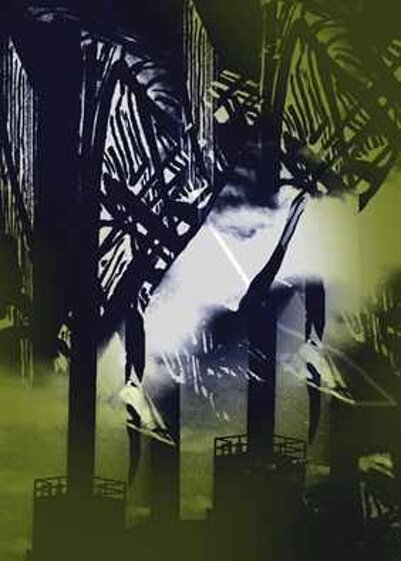
Industrial Archaeology, Urban Drift, Trajectories of Migration
A solo exhibition across two spaces · Mixed media: informal painting and digital photography
There is an invisible geography running through contemporary European cities: the geography of spaces left empty by production and not yet reclaimed by time. Warehouses, smokestacks, courtyards paved with silence — industrial archaeology is a stratigraphy of collective mourning, but also, paradoxically, a form of survival. Not for the city that has lost these places, but for those who, within these voids, find the only shelter available.
Guglielmo Durazzo’s exhibition unfolds through two cycles occupying separate yet interconnected rooms, and this spatial choice is not incidental: it mirrors a structure of thought. The two bodies of work share a common root — the experience of marginality, life at the edges of the system — yet articulate it through different images, temporalities, and visual languages. The first cycle looks downward, toward the earth, toward what the city discards and forgets. The second looks toward the water, toward the routes crossing the sea, toward what disappears without leaving a trace.
In his essay The Art of Oblivion, Manlio Brusatin precisely describes the metamorphosis of ruins: the slow collapse, then the sudden one, and finally the return to nature — the skin of grass, the skeleton of shrubs, the silence becoming a new construction. It is a consoling vision, and an accurate one, but it applies to ruins that the jungle can reclaim: Indian temples swallowed by vegetation, Roman villas slowly consumed by the Campanian countryside. Urban industrial ruins are denied this grace. The city holds them hostage: too close to the center to be entirely abandoned, too deteriorated to be restored without enormous investment. In this limbo, they become inhabited. Not in the architectural sense of the term, but in the sense that escapes maps and censuses: they become places where the homeless find shelter, where undocumented migrants wait, where those denied the right to the city nonetheless exercise the right to exist.
“Ruins — collapsing roofs and rubble accumulated not through violent destruction but through long abandonment — are slow to form. Then they occur in a few instants with the roar of an earthquake. And again, very slowly, in their typical return to nature, the wrecks silently become a new construction made of a skin of grass and a new skeleton of bushes and dead shrubs sufficient unto themselves to grow and reproduce elsewhere.”
Manlio Brusatin, The Art of Oblivion, Einaudi, 2000
It is within this physical and conceptual space that the works of the first cycle are situated. The central triptych performs a precise critical gesture: within the photograph of an abandoned factory, a scanned engraving by Piranesi — a fragment of ruined Roman architecture — is digitally grafted. The operation short-circuits two temporalities of abandonment, two scales of ruin. In both the Carceri and the Vedute di Roma, Piranesi perceived ruins as a sublime grammar, a theater of collective memory in which the past settled like fertile sediment. The industrial ruins of the present are denied such sublimation: they are too recent, too close, too bound to the contingent survival of those who have no alternative. One side panel of the triptych extends this discourse through transfiguration: smokestacks multiply and merge into a graphic entanglement evoking tribal imagery, systems of signs no longer decipherable through the categories of industrial modernity. The artist seems to ask: what kind of writing has this system left in the air? What remains, in collective visual memory, of an entire productive civilization reduced to dust?
"… We walk at the edges of autumn through canals, flashes, and venerable furrows of vanished industry — solemn scenes.”
Franco Fortini, For a History of Industry, 1961
The second cycle inaugurates another register. The near-total absence of color is not an aesthetic choice for its own sake: it is a declaration of method, almost a silent manifesto. Black is the color of the night through which one walks toward a border, of the water that swallows, of the “deepest dark forest” Bob Dylan crosses in his prophetic 1962 ballad. It is the color of what never arrives, of what disappears without leaving a name in the archives.
"… I’ll walk to the depths of the deepest dark forest,
where the people are many and their hands are all empty,
where black is the color and none is the number …”
Bob Dylan, A Hard Rain’s A-Gonna Fall, 1962
The three epigraphs accompanying the works in the gallery — Dylan, T. S. Eliot, Herman Melville — belong to centuries and geographies vastly distant from one another, yet they name the same scene with an unsettling coherence. In Eliot, from the section Death by Water of The Waste Land, the sinking body passes backward through the stages of life: an inversion of time that also becomes an image of the dissolution of identity. In Melville, the closing page of Moby-Dick — “the great shroud of the sea rolled on as it rolled five thousand years ago” — abolishes every distinction between ancient and modern, between history and nature, between what happened yesterday in the Mediterranean and what happened when the first human vessels dared the open sea. There is no space for mourning in these images. There is only the time of the sea, its millennial indifference.
In both cycles, the decision to combine informal painting with reworked digital photography is not a matter of style but of the ethics of representation.
Informal painting — gestural, layered, non-descriptive — operates through a subtraction of control: the gesture precedes thought, matter responds according to its own internal logic. Through this method, what cannot be directly described — the violence of abandonment, the terror of the crossing — finds a form that does not reduce it to illustration, does not domesticate it into a consumable image.
Digital photography functions differently, yet with a complementary role: it enters the process not as neutral documentation but as material to be manipulated, forced beyond its testimonial nature. Scans of historical engravings grafted into contemporary interiors, images reworked to the threshold of abstraction, create a short circuit between photography’s vocation as archive and painting’s vocation as immediate presence. The digital medium belongs to the long duration of memory; painting belongs to the brief, urgent, physical time of the present. The dialogue between the two media forms the technical and poetic core of this exhibition, and perhaps its most original contribution to the debate on the possibilities of art in the face of what resists representation.
ON THE THRESHOLD
These two cycles do not address a spectator meant to be moved to pity. They address someone who inhabits — or could inhabit — the same spaces, the same cities, the same historical time as those represented, or those not represented because they disappeared before they could become images. The threshold evoked by the title is not only spatial: it is the exceedingly thin line between the one who looks and what is looked at, between those who have an address and those who possess only a route, between those who can afford to make art and those who can afford nothing.
Riccardo Dellaferrera, May 2026
Biographical Note
Guglielmo Durazzo (Turin, 1948) has developed, over several decades, a painterly research practice parallel to his legal profession, exploring visual languages ranging from Informalism to the fragmentation of the image. His practice combines traditional techniques — oil, acrylic, drawing, and ink — with contemporary experimentation involving collage, digital photography, plastic materials, wood, and plotter prints on acetate. His cycles investigate themes such as industrial memory, the figure of the artist in the studio, and, in more recent works, conflict and migration. He has exhibited in solo and group exhibitions in public spaces and galleries, collaborating with artistic research groups such as Baires 96 and Il Senso del Segno.