ARTE CONTEMPORANEA ED EVENTI CULTURALI
Swann Art Gallery
CONTATTI
Swann Art Gallery
+39 333 2455018
info@swannarte.com
Galleria d'Arte Contemporanea ed Eventi Culturali
“… La guardava; un frammento dell'affresco appariva nel viso e nel corpo di lei, e da quel momento cercò sempre di ritrovarvelo, sia che le fosse accanto o semplicemente pensasse a lei…” M. Proust
info@swannarte.com
+39 3332455018
Via Bertola 29, 10122 Torino
Via Bertola 29, 10122 Torino
Privacy Policy
Cookie Policy
©
FERNANDO MONTA'
PHYSIS
a cura di Riccardo Dellaferrera
27/08/26 - 16/09/2026
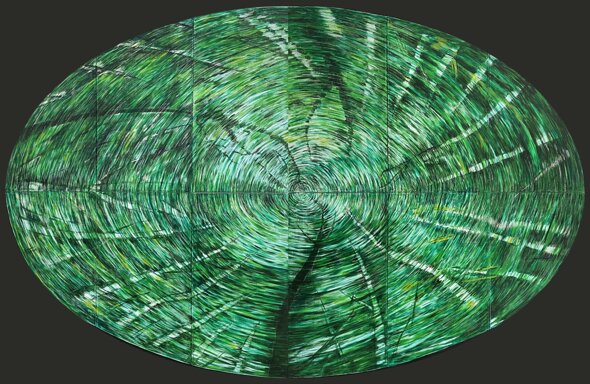
Fernando Montà's painting seems to move in a zone suspended between two seemingly contradictory needs: on the one hand, the need to give form, measure, and precision to reality; on the other, the awareness that reality, even as we attempt to understand it, continues to elude us, escaping the grasp of our gaze and our concept. It is precisely in this tension that Physis, the large painting that gives the exhibition its title, occupies a space. Its twelve panels extend over four meters wide and three meters high. A work that not only demands to be observed, but also seems to ask the viewer to enter into the vision. Its size is, in fact, an integral part of its meaning. Faced with a surface of this magnitude, the eyes alone are no longer sufficient. The viewer is forced to use their own body, to physically engage with the work, to move around, to seek a vantage point, to approach and move away. They are not simply faced with an image: they are within it with their own body. Painting thus becomes a space to be inhabited. And what Montà invites us to inhabit is a forest observed from below, from the undergrowth. Our gaze is immersed in the vegetation and, through it, attempts to reach what lies beyond: the sky, the light, a dimension that never fully reveals itself. The direction of our gaze is therefore ascending, but not separating. To seek the sky, we must first penetrate the materiality of nature, its density, its stratification. We do not look at nature from the outside.
We look from within nature
It is a crucial distinction. The point of view is not that of a subject placed before an object, but that of a being who finds himself immersed in the very reality he is attempting to perceive. The forest is not simply what we see: it is the place in which we find ourselves while we see. From this perspective, Physis questions one of the fundamental structures of our way of knowing. Western culture has often thought of seeing as a distancing: to know, one must distinguish, separate, delimit, place before oneself something that becomes an object. The gaze thus creates a distance between the observer and what is observed. Modernity has taken this attitude to extremes. Reality can be measured, classified, calculated, reproduced; what is presented to the gaze progressively becomes something to be mastered through scientific and technical knowledge. Seeing increasingly means making available. But Montà's painting seems to elude precisely this logic. In his works, seeing no longer coincides with knowing. The vegetation is recognizable, but not completely identifiable. The forms are present, but not entirely available. The light is real, but cannot be grasped. It penetrates the trees, passes through the foliage, settles on the painted surface, and, just as it seems to reveal something, it returns to subtract it. It is a light that does not simply illuminate an object: it caresses the gaze. And perhaps this is where one of the most profound aspects of Montà's painting lies. His work seems to suggest that not everything needs to be known. That the need to understand, delimit, and define can be suspended to make room for a more primal form of experience: perception. Before thinking what we see, we see. And perhaps not only chronologically. Perception, in Montà, seems to precede thought also in an ontological sense: it is not simply the first moment of a cognitive process that will culminate in knowledge, but an autonomous mode of relating to the world. The work, then, does not simply represent a forest. It represents the very instant in which a perceiving subject and a perceived reality enter into a relationship.
In this sense, it is possible to compare Montà's painting to George Berkeley's radical intuition that esse est percipi, "to be is to be perceived." Not because Montà translates Berkeley's philosophy into painting, but because his work seems to pose a similar question: what remains of the distinction between the perceiver and what is perceived in the very moment of perception? The answer seems not to be a separation, but a relationship. The subject is no longer simply the one who observes nature. It is part of the perceptual event through which nature manifests itself. In this sense, Physis, a word that in the Greek tradition refers to nature, but also to the coming into presence, the emergence and manifestation of what is, is not simply the name of an image. It is the name of a condition. Nature is not something that is out there. It is what we are within.
The rigor of the vague
It is precisely here, however, that the second movement of the exhibition emerges. Because Montà's painting, while immersing us in nature and perception, is also constructed through an exercise of extraordinary precision. His mark is neither casual nor shapeless. On the contrary, it possesses a powerful icastic capacity: it makes visible, determines, delimits, constructs. In Physis, this tension reaches an almost paradigmatic form. The entire composition is inscribed within the rigorous geometry of a large ellipse. The ellipse constitutes an abstract, precise, almost mathematical structure within which an extremely complex visual material is organized. On one side, therefore, the rigor of form; on the other, the incessant flow of sensations. On the one side, precision. On the other, vagueness. Montà's art seems to exist precisely in this interval. His painting is icastic in the fullest sense of the term: the mark possesses a strong clarity, a constructive clarity, an ability to determine the form. And yet what it represents is never completely determined. The sun filtering through the vegetation produces a dazzling light, interrupting clarity, and making vision uncertain. Our eye, just as it strives to reach the light, loses the ability to fixate on it completely. It's a paradox: the painter's precision produces the indeterminacy of vision. His mark is confident, clear, meticulous; but the perceptual result is an image that continually eludes complete definition. The more we observe, the more we realize that reality does not coincide with the sum of its details. It is necessary to observe the multiplicity in its totality and, at the same time, penetrate the microscopic. Vision continually oscillates between the detail and the whole, between what is determinate and what, precisely in its complexity, becomes indistinct. It is here that the comparison with Leopardi becomes particularly fertile. In the Zibaldone, the vague, the indefinite, the uncertain are not simply deficiencies of knowledge. On the contrary, they possess an aesthetic power of their own. What is not completely delimited can open a space to the imagination; what is not entirely possessed by the gaze can be more pleasant, more profound, even closer to infinity. Something similar happens in Physis: the image is not beautiful despite being indistinct. It is also beautiful because it is indistinct. Its incompleteness does not represent a defect of vision, but the very condition of its openness. Yet—and this is the central paradox of Montà's painting—the indeterminacy arises not from an uncertain sign, but from a rigorous one. The painter who leads us toward the vague is a painter of precision. This apparent contradiction is perhaps one of the most interesting aspects of his research: the vague is not achieved by renouncing form, but by pushing form to the limit beyond which it can no longer guarantee absolute knowledge of reality. Exactitude, pushed to its limits, discovers its own limits. And precisely beyond that limit, the vague begins.
The Indefinite and the Infinite
Once again, Leopardi offers us a key to understanding. The vague and the indefinite are intimately linked, in his poetics, to the human desire for the infinite. Man tends toward that which he cannot fully represent; he imagines the absolute precisely because he cannot possess it through experience. In this sense, Physis seems to stage a profoundly human condition: the desire for the infinite and the impossibility of knowing it. The eye searches for the sky through the trees. But the sky is never fully reached. Light appears and retreats. The vegetation offers itself in its multiplicity and simultaneously prevents a complete vision, and our gaze progresses toward the beyond, yet necessarily remains situated, embodied, finite. The work thus also becomes a reflection on the relationship between the idea of absolute space and time and our empirical experience of space and time—necessarily relative, limited, and corporeal. In this sense, Physis's ellipse seems to represent the abstract rigor of a form that claims to contain reality. But what happens within it continually escapes that claim of containment. Geometry defines the field and encounters the perception that renders it infinite. The rigor of form encounters the flow of sensations. Abstraction encounters nature. Exactitude encounters the vague. And perhaps it is precisely in this tension that Montà's painting finds its own possibility of truth. Not a truth understood as a perfect correspondence between image and reality, but a perceptual truth: the awareness that our every relationship with the world is necessarily mediated, situated, incomplete.
A Common Substance
Ultimately, however, what Physis seems to question is something even more radical: the very separation between man and nature. Montà's painting does not seem interested in representing nature as a landscape placed before man. His gaze is not that of a traveler observing the world from an external perspective, nor that of a scientist analyzing it to understand it. It is an immersed gaze, a body within another body, a being within being. This is why the monumental dimension of the work is not merely a compositional choice. It forces the viewer to physically experience this condition. It does not allow them to comfortably maintain distance. It asks them to enter the surface, to place themselves within the vision, to transform their own body into part of the experience of the work, thus making painting a place of identification. It does not simply represent nature: it puts us in the position of experiencing nature. In this regard, it is possible to evoke Spinoza and his idea of nature understood not as the sum of all existing things, but as a single substance, infinite and indivisible, of which finite beings are expressions. Deus sive Natura: God, or Nature. Without simplistically superimposing Spinozian philosophy onto Montà's research, this reference nevertheless allows us to understand the exhibition's ultimate direction. What painting seeks is not necessarily the representation of an external nature, but the possibility of making a common substance sensible, a continuum in which the viewing subject and the world viewed cease, at least for an instant, to be completely separate entities. Montà's sign, then, does not merely represent, but rather relates and, perhaps even more radically, enables identification. The precision of the sign leads to the inevitable approximation of perception; definition leads to the indefinite; form leads to its transcendence. Not because man is incapable of knowledge, but because all human knowledge necessarily remains situated within a perceptual experience, this remaining our most profound form of openness. For if we cannot possess nature through the concept, we can still feel it, transforming indeterminacy without immediately interpreting it as a problem to be solved. This is perhaps the most radical gesture in Fernando Montà's painting: restoring to perception a dignity that our culture of knowledge continually tends to strip away. Before Physis, therefore, we are not simply called to see a forest, but we are called to experience our own seeing. The beauty of Physis lies in this distance between what we can determine and what we can only intuit, and it is precisely in this approximation, aesthetic even before cognitive, that we can recognize our most authentic belonging to the world.
Riccardo Dellaferrera, August 2026