ARTE CONTEMPORANEA ED EVENTI CULTURALI
Swann Art Gallery
CONTATTI
Swann Art Gallery
+39 333 2455018
info@swannarte.com
Galleria d'Arte Contemporanea ed Eventi Culturali
“… La guardava; un frammento dell'affresco appariva nel viso e nel corpo di lei, e da quel momento cercò sempre di ritrovarvelo, sia che le fosse accanto o semplicemente pensasse a lei…” M. Proust
info@swannarte.com
+39 3332455018
Via Bertola 29, 10122 Torino
Via Bertola 29, 10122 Torino
Privacy Policy
Cookie Policy
©
VIOLA GESMUNDO
FELICIANA MORE
IN-PERFETTI
Misfit Bodies
a cura di Alice Zatti
20/06/2026 - 24/07/2026
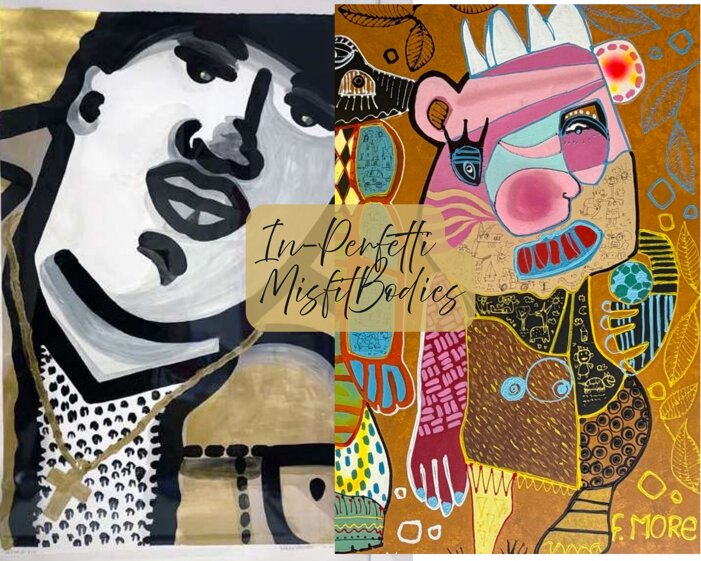
Swann Art Gallery presents an encounter between two artists of the same generation but coming from different geographical and cultural backgrounds: Viola Gesmundo, an Italian artist working across illustration, urban art, and research on the body, and Feliciana More, a young American painter originally from Louisiana, now based in Venice. Through immediate and strongly narrative figurative languages, the two artists address themes that run through contemporary life: the relationship with the body, identity, social stereotypes, inequality, freedom of expression, and the possibility of building authentic forms of existence outside of conventions.
The microcosms created by Feliciana More are populated by bizarre and eccentric characters. Although the artist's style may appear naive, recalling children's drawings and influenced by Art Brut—particularly Dubuffet's visual language in its use of vivid, saturated colors and the distortion of figures and faces rendered with bold lines—the work offers a profound reflection on the human condition.
A clear example of this is the painting Big Brother, where humans and animals coexist in a dystopian reality. All the subjects, depicted in everyday activities, are watched by a large eye, a surveillance camera that monitors and analyzes every movement, eliminating any possibility of privacy or personal freedom: an evocation of Orwell's famous warning about constant surveillance in 1984. While the artist seems to suggest that life should be read as a great game, in which each of us wears a mask and plays a role (Playing Together), at the same time she does not forget that our society is marked by issues that genuinely affect how people live. Among these we can highlight social and economic inequality (The King and the Queen) and the difficult relationship with the urban spaces we inhabit. Feliciana's American origins are reflected in her output and in her choice of subjects, details, and visual languages, which also draw inspiration from the work of Jean-Michel Basquiat. Just as Basquiat incorporated certain words he considered meaningful into his paintings as part of the work itself, Feliciana creates a kind of metanarrative in her pieces: the surfaces of her figures are characterized by decorative polka-dot or hatching patterns, or are filled with stylized figurative motifs, graffiti, and drawings that invite us to reflect on the work itself.
Echoes of an American passion are also visible in Viola Gesmundo's output. In one of the paintings on display (Biggie Small), it is in fact possible to admire a portrait of Notorious B.I.G., the well-known American hip hop artist. This musical genre was a youthful passion of the artist's, one that drew her toward the world of street art and murals. The choice of subject reveals Viola's attention and sensitivity toward the world of outcasts and the marginalized, themes also explored in Notorious B.I.G.'s own lyrics, which speak of dedication to those who doubted him, to the people who once called the police on him while he was getting by on the street, and to the drive to provide for his family.
In the works Anywhere and Nudo, Viola explores her relationship with her own body. In particular, in Anywhere, the skin of the woman portrayed becomes a canvas on which to paint—a metaphor for the artist who uses any surface available to express her creative drive, but also a metaphor for life itself, conceived as a work of art of which we are the sole creators. Throughout her work, Viola places at the center the theme of gender equality and the fight against patriarchy and stereotypes, echoing Dubuffet's rejection of the idea that beauty and ugliness are fixed categories assigned to objects and people, which he denounced as an unhealthy convention. Breaking away from the Western figurative tradition, in which the female body must conform to rigid aesthetic canons, Viola promotes a philosophy of self-acceptance and of a free, unconventional eroticism: in Spaghetti Caldi, for example, she focuses on the fascination with sitophilia, a form of sexual fetishism in which food and the body interact to generate arousal.
Following their distinct sensibilities, Feliciana More and Viola Gesmundo both champion a fundamental idea: that art has the responsibility to convey specific messages and the capacity to embody thought. In a complex world, burdened by cultural and social legacies in which the logic of single-mindedness dominates, it is possible to cultivate an alternative sensibility and way of life. This brings us closer to the true essence of being unique and different individuals, making us proud of who we are.
Alice Zatti, 14/06/2026